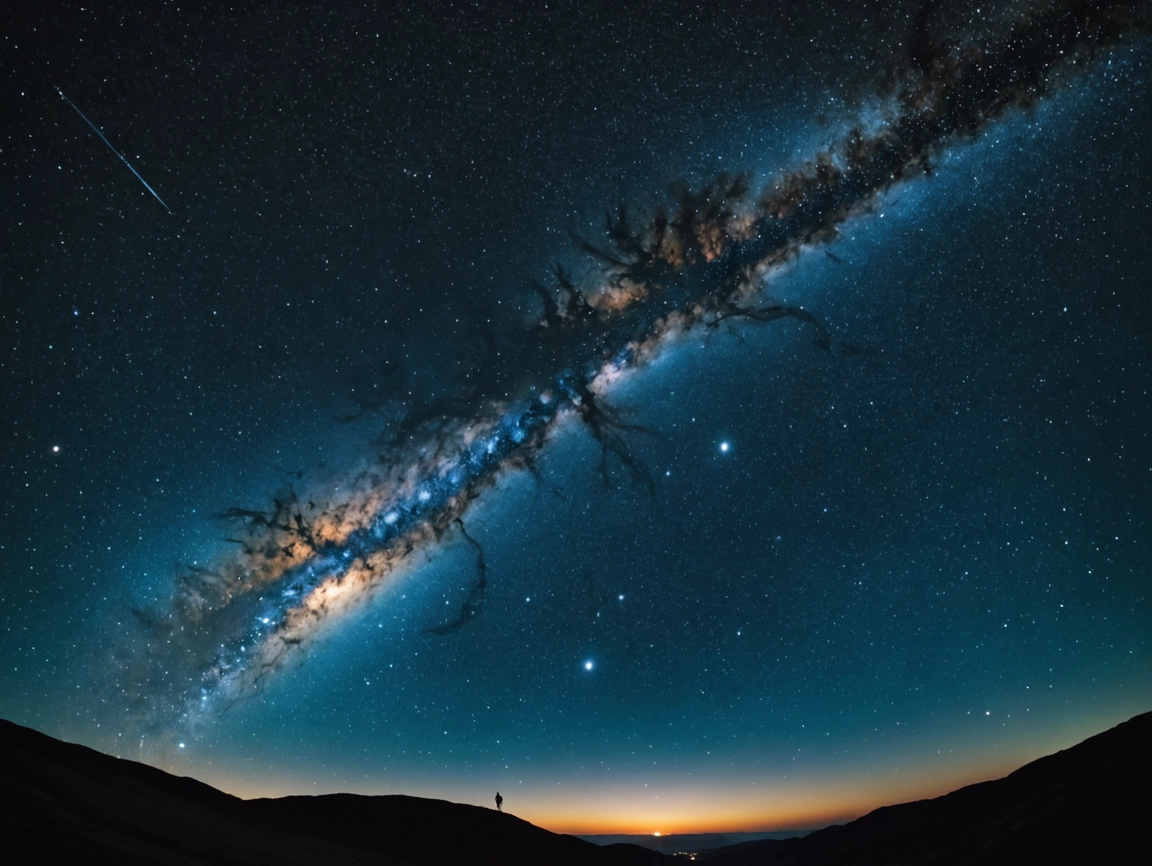
Have you ever found yourself full of questions after staring into the night sky? I sure have. After gazing into the stars I generally feel small. I mean who wouldn’t? If our mind has even a partial grasp at the depth of the cosmos, how else would we feel? Strangely though, sometimes it makes me feel the opposite. I mean if space is really that large and we are the only ones out there. How big does that actually make us? If the expanse of the heavens was created by an intelligent being and mankind has yet to discover another planet containing life, how important does that make Earth? Our galaxy alone is said to be 100,000 lightyears across and we are just 1 of 3 trillion estimated galaxies in existence. Jeremiah 33:22 says “the stars of the sky cannot be counted”. This declaration hasn’t stopped mankind from trying. For decades Astronomers have been creating star catalogues. These star catalogues identify the known stars and deliver their standardized stellar designations. Even though almost every scientist admits the stars are innumerable, Astronomers have estimated that are 300 sextillion (3×10²³) stars in the Universe. I know we don’t count things by the sextillions very often so to help us quantify that, there is hundreds of thousands, millions, billions, trillions, quadrillions, quintillions and then we have sextillions. Let’s break that down a bit more. Let’s say we liquidated every dollar from the entire stock market. Then we confiscated every dollar of cash, every coin and every digit of crypto currency from the world’s 7.594 billion people. Then, somehow we managed to get change in pennies for this wealth. Our stack of pennies would now reach the moon (and back) 41 times. Lets say we then took our pennies and with a tiny saw cut each and every one of them into 10 little pieces… there would still be over 3.3 million stars for every piece of each penny. That of course, is just in the observable universe.
I know that sounds impressive but we haven’t even talked about the size of each star yet. For a moment think about how big your house or apartment is compared to you? How many people can fit into your home? Then think about how big your neighborhood is compared to your state? At this point we already feel small right? If we continue with these types of thoughts, we inevitably realize how insignificant we are even in our own country. The United States is only 4.25% of the worlds population. Crazy huh? What’s even crazier is that the average size of those 300 sextillion stars, is a million times larger in mass than our entire planet! Remember our penny stack we cut into pieces? Each one of those pieces, is 3.3 trillion earths. But in all the cosmos, there is only 1 you… and 1 me.
So how big is God? If we are going to make an attempt to quantify God, it only seems fitting to first quantify one of His creations. This happened in the very first sentence in the entire Bible. In the beginning, God created the heavens… Genesis 1:1. This is the birthplace of the cosmos and for over 3,000 years men have looked to the stars to understand our existence. The first documented records of systematic astronomical observations date back to the Assyro-Babylonians in around 1000 BC. Most of us know about The Hubble Space Telescope. But did you know it’s over 26 years old now? Since 1994 technology has continued to advance and every year men get closer to knowing more about the heavens. Like the $465-million Large Synoptic Survey Telescope (LSST) built in 2014. Astronomers and Cosmologists are hoping the LSST will help them learn more about Dark Matter, a bizarre ingredient in space that does not emit light or energy yet makes up 27% of space. The James Webb Space Telescope is about to be launched into space and it’s not only getting physically closer to space but it’s 100 times more powerful the the Hubble Telescope. Each time we make advancements in technology its unclear if it gives us answers or leaves us with more questions. Nevertheless mankind continues reaching into the vastness of the stars. In our attempt to quantify God it only seems right to look toward this expanse. Is there a fingerprint of a master architect with each star?
For our attempt to quantify God I would have chosen the furthest planet in the furthest galaxy known to man but we can’t actually see into the furthest Galaxy known to man, we can however see the galaxy itself. So until The James Webb Space Telescope is launched, we’re going to have to choose the galaxy known as Gn-z11. It’s the farthest galaxy yet discovered by man. Gn-z11 is a high-redshift galaxy found in the constellation Ursa Major. You can actually look up a picture of Gn-z11 on your computer, just in case your making travel plans. It pretty much looks like a tag mole in the sky. A tiny, seemingly red, blotchy 5 pixel blob in the 5,725,008 pixel image published by Team Hubble. This galaxy is estimated to be 31,960,000,000 lightyears away. That’s 31.96 billion lightyears away from planet earth.
In order to quantify anything we first have to establish some quantifiable ways to measure distance. Especially distance in space. The starting place for measurements in space is light. I mean why not start with the fastest thing known to man. To help us better understand how fast light travels lets take a few steps back and first understand how sound travels. I’ll never forget the first time I witnessed anything break the sound barrier. It totally blew my 12 year old mind! It may also be responsible for starting my love for measurements and mathematics. It was a bullet weighing 3.23g traveling at a speed of 4000ft per second. I actually watched it impact the target but heard absolutely nothing. It seemed like forever until I heard the sound of the gun fire. This intrigued me beyond words back then and quite frankly still does. Sound travels 1,125 ft in a single second. Air temperature actually effects these metrics but assuming its around 59 degrees that’s 761.2 mph. That’s 150.39% faster than the fastest car in the world, The Bugatti Chiron Super Sport which tops out at 309mph. But light is off in a category of its own when it comes to speed. The Bugatti Chiron delivers an incredible 1,622 brake horsepower at 7,000 rpms. For comparison that would be the equivalent of 7.99 Toyota Camry engines in one car. In order to deliver that horsepower The Bugatti would have to be running at 7,000 rpms (revolutions per minute), that simply means that in just one minute the engine’s crankshaft would have made a complete revolution 7,000 times. That’s incredible to even try to comprehend from an engineering perspective. But where would light be in that time frame? By the time the Bugatti was finishing a minute of revolutions, light would be been sitting there waiting patiently after it’s 448th time circumnavigating the planet earth. Ladies and Gentlemen, may I introduce to you, our first quantifiable resource willing to step into the ring in our attempt to quantify the cosmos. Weighing in at 2.2 million times faster than the Bugatti Chiron, Light itself.
Cosmologists have taken our friend light and created unit of astronomical distance equivalent to the distance that light travels in one year, which is 9.4607 × 10¹²km. We will break this down in a more understandable way here shortly. Our second competitor to take on the measurement of space is the parsec. A parsec is defined as the distance at which one astronomical unit subtends an angle of one arcsecond. Or in English its 3.26156 lightyears. Our target galaxy, Gn-z11, is 9.8 billion Parsec away from us. Isaiah 40:12tells us that God has “measured off the heavens with his fingers.”But in an attempt to Quantify God (and His fingers) Let’s attempt a grasp at our furthest known galaxy Gn-z11.
We’re going to turn to some not-so scientific examples so that we all (including me) can comprehend. Our examples our going get a little crazy, but I have a passion for precision and a love for all things analytical and mathematical. So I’ll keep the math scientifically exact. I also have a passion for engineering and all things fast, especially cars. That being said, as we plan our trip to Gn-z11 together, we have to start with some means of transportation. Why not choose another exotic and beautiful super car! The Lamborghini Aventador Superveloce. The fastest (production) car ever built, or for the sake of our mathematical attempt to measure God… The fastest Space Lamborghini ever built! Our trip isn’t going to be cheap so let’s pretend like money is no problem for this journey. You only plan a 9.8 billion Parsec road trip once in a lifetime, so lets live a little. With a top speed of 219 mph or 352 kmh and a 0-100 mph of 10.1 seconds, our space Lambo is ready to get some distance behind us. Let’s not get too hasty though. I think it would be wise to do some quick calculations before we leave.
In order to pull this trip off we’re going to select a pilot. We can’t select just one though, because this trip is going to be about 26.849 billion hours long or 3,064,990 years. With the average lifespan today our first pilot would die off before accomplishing 0.002% of our rather long road trip. So, if we want to keep up on average family life in America and have some future pilots, we’re going to have to choose a male and female that can procreate. A generation in now considered to be 15-20 years. We’ll use the far end of that spectrum and say that our trip is going to be 153,259 generations long. Lets just turn a scientific blind eye toward that the issue of the genetics for our future pilots and continue to calculate our next issue… Fuel. At our cruising speed of 219 mph we’re going to be getting around 8 mpg which isn’t bad for a 12 cylinder 397 cubic inch engine. That means we are going to require exactly 735 billion gallons of gas. We can’t put anything besides premium in the Lambo so I did some research and our local QT can fill us up for $1.69 trillion. Good news however, if we can get approved for the QT rewards credit card (with at least a $1.69 trillion limit) we can save 1¢ per gallon, thats a savings of $7.3 billion! My parents taught me to pinch pennies. (you can think me later) Our precise cost of fuel is now $1.68315 trillion. If we wanted to get really scientific here (and we could) our gas milage might go down a bit pulling the 4.5 trillion pounds of gasoline with us. Obviously finding a place to put that fuel and another couple million scientific impossibilities are still in our way but for the sake of mathematical calculations and thanks to the QT Rewards card, we are now filled up and ready to go! Pedal to the metal and in less than 30 seconds we are at our cruising speed of 219 mph and on our way to Gn-z11.
Alright, We’ve had some laughs buts it’s time to get serious. I know this trip is impossible, but mankind likes to put faith in themselves. People like to talk about the strength and endurance of the human spirit, about the resilience of man and his creation. About our wisdom and our intelligence. So for those people let’s pretend we’ve endured. The 3 million years, 11 months, 3 days, 15 hours and 36 minutes have past. We’ve burned through 735 billion gallons of fuel and let’s pretend we’ve managed to reproduce 153,259 times. Let’s pretend that the temperature of deep space isn’t -359.81 degrees past death at hypothermia. But by the strength of the human spirit we’ve journeyed to quantify the vastness that is God. We’ve road-tripped through the “work of His fingers, the moon and the stars, which He has set in place.” Psalms 8:3.We’ve past stars 1 million times larger than our entire planet and soured through the heavens which He “stretches out like a curtain” Isaiah 40:22. Over 3 million years ago we left the planet earth which Job says God “hangs over the void on nothing” Together we’ve put 5.88 trillion miles on our space Lamborghini. Out of our windows we’ve first hand witnessed the beauty of cosmos which both “exist and were created by His will” Revelation 4:11 .
At this depth in space we’ve now seen what the greatest minds of man have spent thousands of years and trillions of dollars trying to reach. We are 99.996% further that any human has ever been in space. We’ve journeyed 23,647 times further than Apollo 13 and 5.867 trillion miles further than any human-made object has ever dared to soar in space. According to Darwin’s theory of evolution we’ve been in space longer than it took for primates (Austra-lopithecus) to become humans (Homo sapiens). By the shear power of human will, the help of mathematics, and 4.5 trillion pounds of gasoline we have now put 00.004% of our own galaxy behind us. But don’t fret, in just another 73.4 million years we will outside of own galaxy and ready to get some real distance behind us! At this point in our journey we have already completed 1/32,000,000,000th of our trip to Gn-z11. We just put an entire lightyear behind us guys, only 31 billion left! Or if we look at this a little differently, if our journey from Earth to Gn-z11 was the equivalent of circumnavigating planet Earth on foot, our 4.5 trillion pounds of gasoline has taken us roughly 1/700th of our first step. We would have traveled just a hair more then the thickness of a penny. But there’s still hope! We just need 1.35 quadrillion more lifetimes and we will arrive at Gn-z11.
I must apologize though. I’m generally pretty good at mathematical calculations but we have one more serious issue with our calculations. Space… is ever so obedient. Since the moment it was created it has never stopped being created. When God said “Let there be light!” He never came back and said “You can stop now”. American astronomer Edwin Hubble made the observation that space has never stopped expanding. He was the first to scientifically prove this theory in 1925. A new estimate of what is now called “The Hubble Constant” estimates the universe is expanding at 74 kilometers (46 miles) per second per megaparsec. A “megaparsec” is a million parsecs or 3,261,563 lightyears. This means because space is actually expanding (not just growing) the farther away a galaxy is from us, the faster it is moving away from us.
With our present understanding of the universe, space in the galaxy of Gn-z11 would be ever expanding at a rate of 450,000 miles every second. That means that for every mile we’ve driven in our Space Lamborghini, Gn-z11 grew 7.4 million more miles away from us. In our 3 million year long theoretical mathematical journey, Gn-z11 has become 4.347 quintrillion miles further away away from planet earth.
Funny isn’t it. Our first step at quantifying God was to attempt to quantify just one of His creations. At the end of our 3 million year long simulation and at total cost of 38,944 lives, we were 00.000000004% closer to Gn-z11. In the finality of it all though, the cosmos are throwing themselves in obedience toward the feet of their creator at a speed of 1.6 billion miles per hour. At least thats how things work around Ursa Major in the distant high-redshift galaxy of Gn-z11.
“The heavens… even the highest heaven, cannot contain Him” 1 Kings 8:27
If even the expanse of the cosmos cannot contain God, If we cannot even grasp one of the two trillion observable galaxies in the universe. How big is God? If even some of the greatest minds is science agree that space is infinite, How then do we quantify it’s Architect? We can’t see past Gn-z11 right now, but if we could, what would we see but more of His handiwork? “He has measured off the heavens with his fingers…” Isaiah 40:12. How then do we measure God’s fingers? In lightyears? Parsecs or megaparsecs? Maybe it’s as simple as that, the point of the innumerable stars of the cosmos. Just to show us that even the worlds greatest mathematicians cannot even quantify the width of his finger. Even in 1.35 quadrillion lifetimes.
There is one thing I’ve discovered that is deeper and more infinite the the cosmos. The depths of God. Our space Lamborghini won’t make it there but there is someone who does. “The Spirit searches everything, even the depths of God.” 1 Cor 2:10. How much deeper and further is the depths of God than the depths to Gn-z11? I can only imagine megaparsecs don’t even come close. Yet in all the cosmos and in the unquantifiable depths of God, there is indeed a distance that is too far for God. It’s 17 millimeters. The 0.669 of an inch from the outside of your skin, to the inside of your heart.
In around 60 AD, the writer of book of Acts said that same Spirit that searches the depths of God was poured out ON all people. But His desire is not just to be on you, He desires to be in your heart. Just 5 days after creating the Cosmos He created man. Unlike the Heavens, man was not created just to show the splendor of his creator. Man was created for relationship. After He created man, The Architect of the Cosmos came daily to walk with man and talk. The same God who formed Gn-z11 walked with man!
When through disobedience, sin entered this world. People say it brought death with it, and it did. But death entered in it’s most deceiving form, separation. What’s the most devastating of all things to the heart of the Creator? Quantifiable distance. The one who challenges us with lightyears and megaparsecs was grieved with the distance between Him and man.
Then, the Creator of the cosmos openly allowed Himself to be challenged. What price would He pay to end the separation? To restore the separation between Him and man? He answered in a way only The Author of all humanity could. Weighing the pain of the separation from man, searching the hearts of all living creation for the most precious thing in all existence. Then, He found the highest conceivable price that any living being could ever pay. The life of their child. Then… He offered up His son.
Megaparsecs are nothing to an infinite God, but us being just 0.669 of an inch away from Him? That… He’s willing to die for.